
A work that bears witness.
The sun has an intensity today, the bright blue sky beams down, almost asking to be painted. It feels typically Australian. The haze in the distance plays with colours of violet, mauve and fairy wren blue.
Years before, this land was cleared for this horizon. Cleared for growth, for agriculture, for an economy ready to expand. Once a land of eucalyptus, now a land of pasture….but for how long? Survey lines and rusty fences intersect the landscape, creating patterns that suggest what might come next.
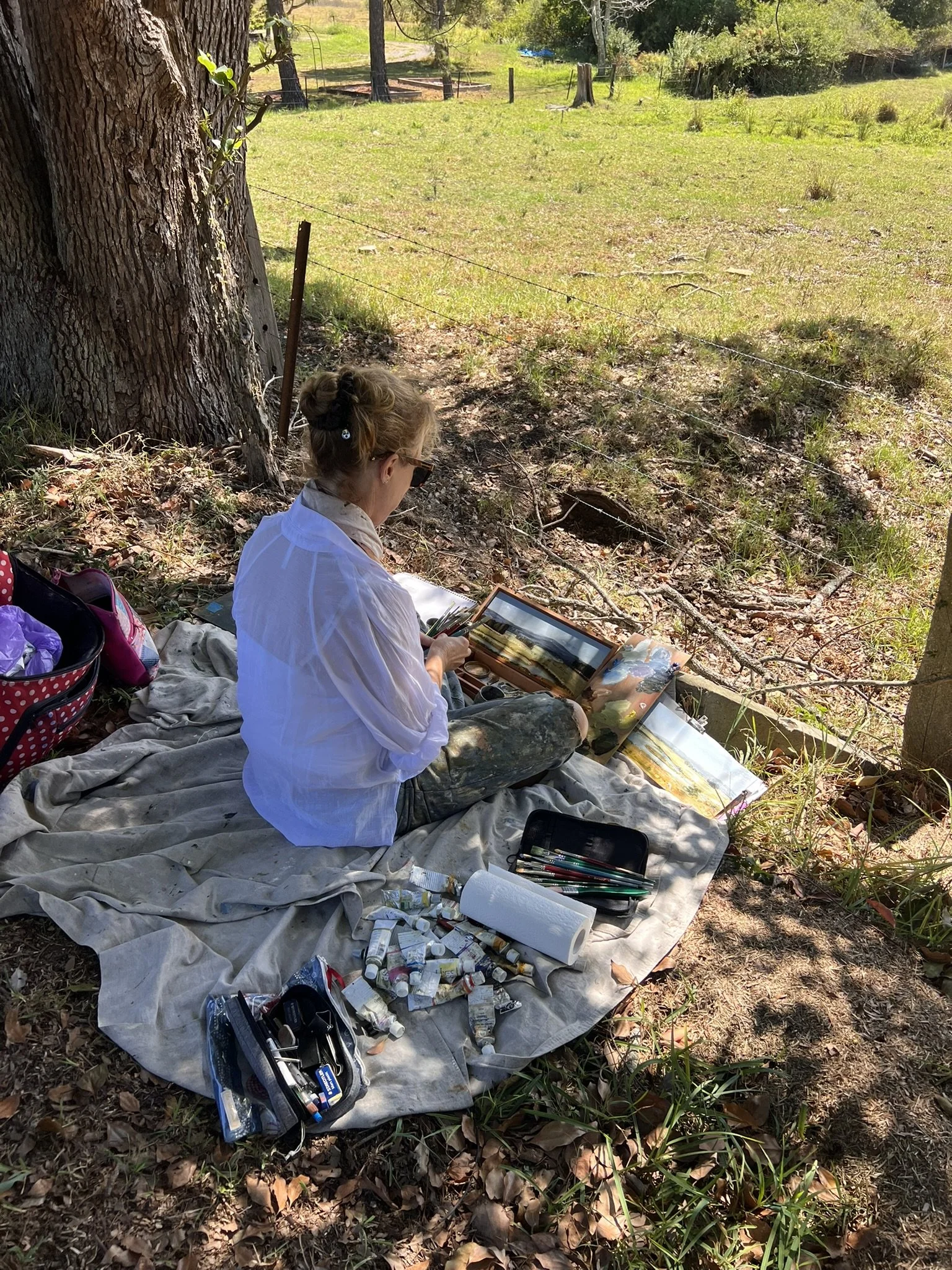
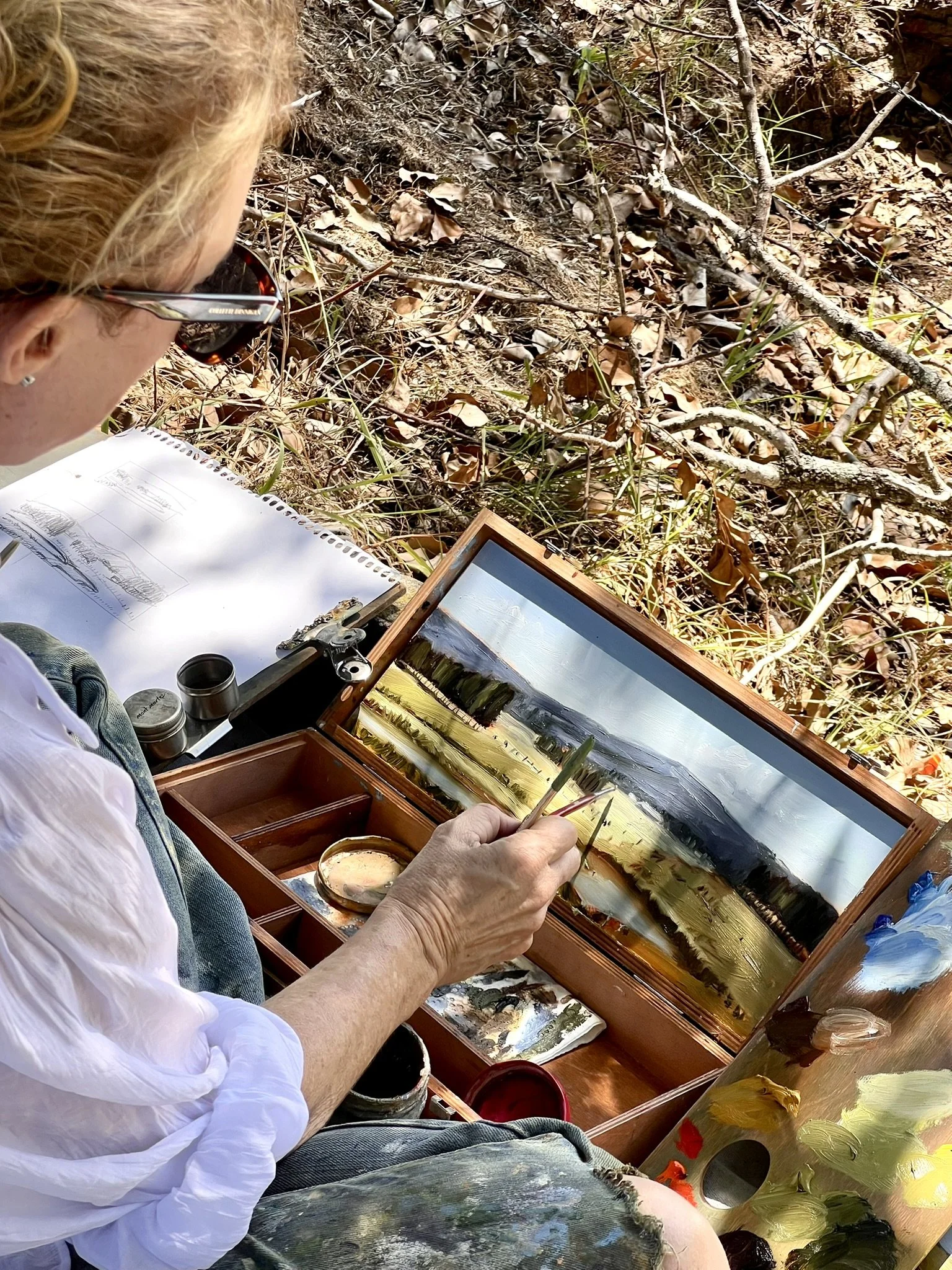
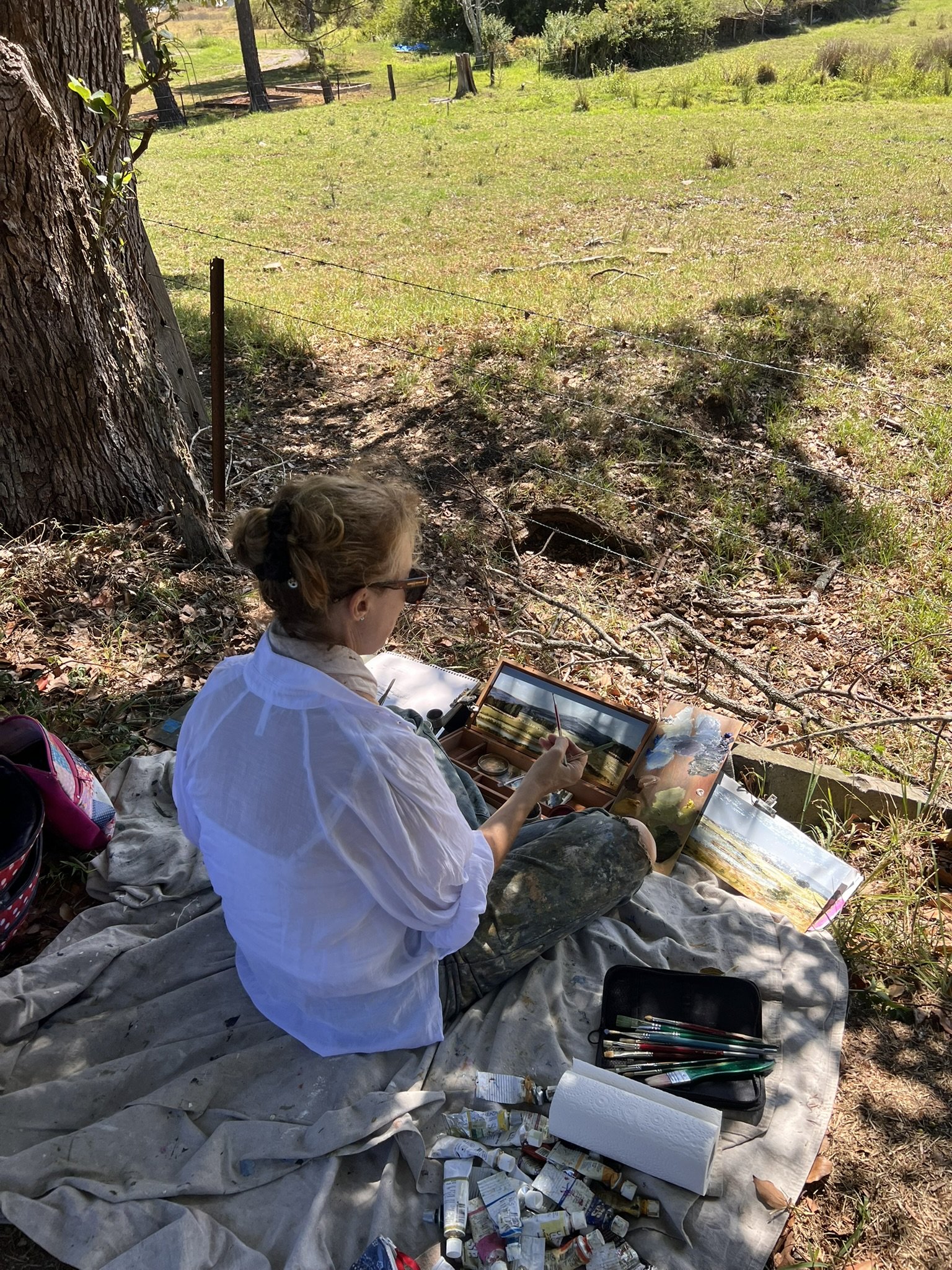
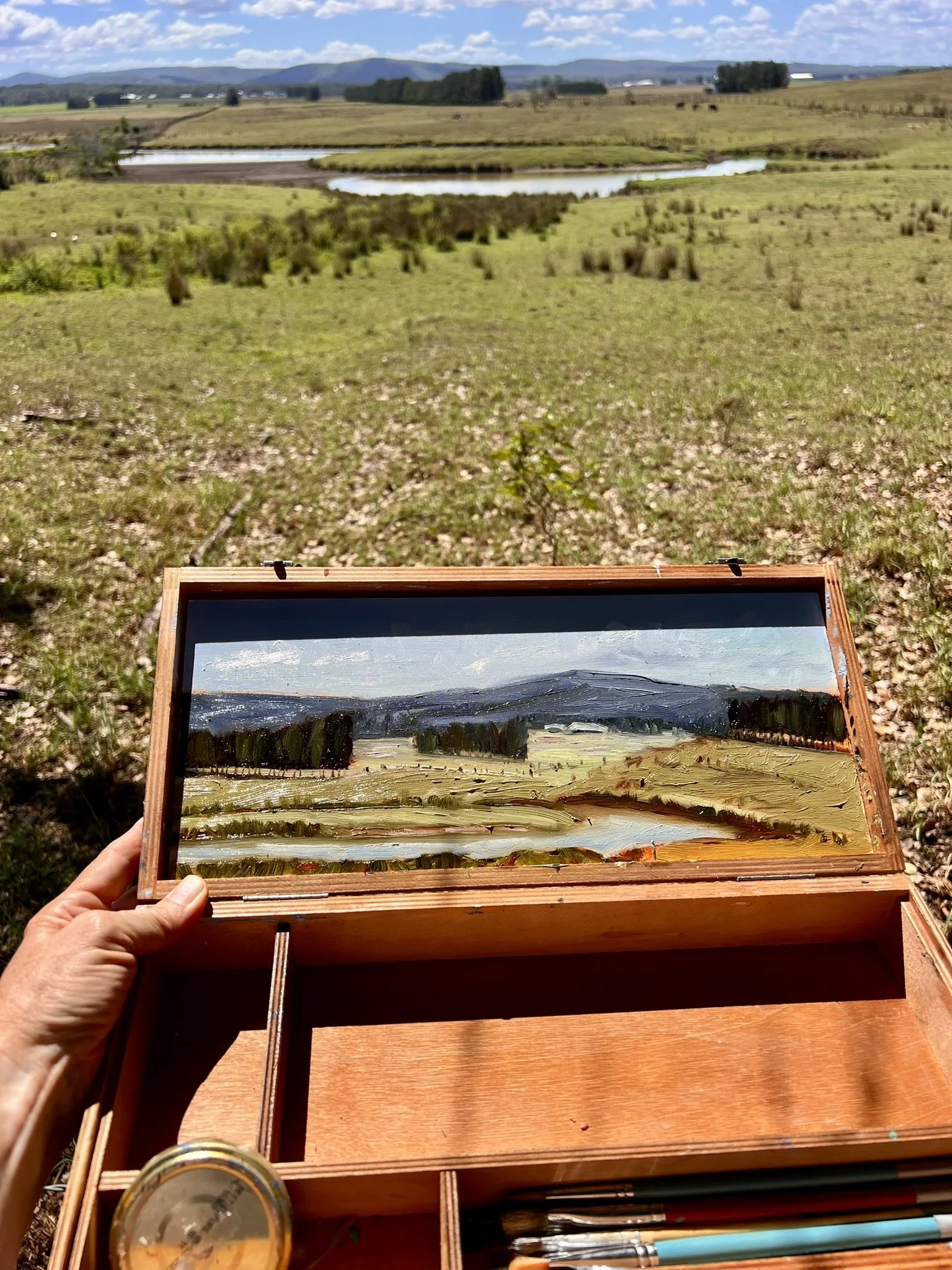
Images: Recent painting trip to Hinton, NSW.
When painting en plein air you become aware of the presence of time. That this landscape you are witnessing, painting, may not be the same in the future. There is a tension between being present and also aware of what is coming. As much as you are in the moment, the light falling on objects, the sun on your back, the wind on your face, there is also the awareness that this moment, this landscape, will pass.
To paint en plein air is to remind yourself that you are an observer, a collector of change. There is a tension between sentimentality and loss, with beauty and awe. A quiet grief sits underneath it with the thought that this view might disappear in time. A green pasture becomes a kind of canvas for something else. A future housing development. A fast-food store. Something flatter, harder, without trees.
Am I preserving something or recording its disappearance?
There is a resistance to make “just a pretty picture”, but instead to record what is there and a kind of time capsule in paint. The act of painting itself becomes a way of holding what is in front of you, even if only briefly. When artists first moved out of the controlled space of the studio into the wild outdoors, they accepted the challenge of painting something fleeting, something that refuses to stay still.
The act of painting outdoors is to catch a glimpse of the world as it changes. No moment is the same. The light shifts constantly, colours intensify then fade, shadows move with passing clouds, foliage never behaves the same way twice. There is a challenge in this which is to capture what was there, even as it disappears on second observation.
Is this a metaphor for our changing landscape? A landscape that slowly gives way to the demands of urban growth?
My brush daubs paint across the board, chasing light and form. It becomes instinctive and I rely on process, on memory, on feeling, to mix and place colour. There is no time to languish. This is the nature of painting outside.
In a workshop I recently held, a student finished early. Packing up her equipment she said, “I realise now that I am a studio painter.” I understood that immediately. I too value the studio. But there is something deeply satisfying in painting against the elements , the weather, the insects, the constant movement and arriving at something resolved.
A work that bears witness.
Yours in art,
Rebecca
Forthcoming exhibition:
”Hold the Horizon”
June 2026
Studio Release
The Moree Gallery
