
Scraggy, Bitty, Vast: Painting a Landscape That Refuses Order
“The Australian landscape has problems for a painter. It is not tidy, it is not well organised as so much European landscape is. It can be scraggy, bitty, textured, without structure. Much of it is just texture and space and light, far distances and close-ups, in and out of focus. Elisabeth somehow manages to make the viewer aware of all these things yet manages to bind them together into a coherent structure.” Guy Warren 2012
When artist Guy Warren wrote about Elisabeth Cummings work, he identified something essential about painting the Australian landscape. He spoke of its resistance to tidiness and its lack of organisation, its scraggy and bitty character, its glare, its distances, its refusal to fall neatly into structure.
It is not an easy landscape to compose.
Cummings’ oeuvre demonstrates this beautifully. Her paintings do not smooth the land into harmony. They do not impose European compositional logic onto something that fundamentally resists it. Instead, they allow density and space to co-exist. Her surfaces feel grown rather than arranged. They are alive with interruption, fracture, scrub and air.
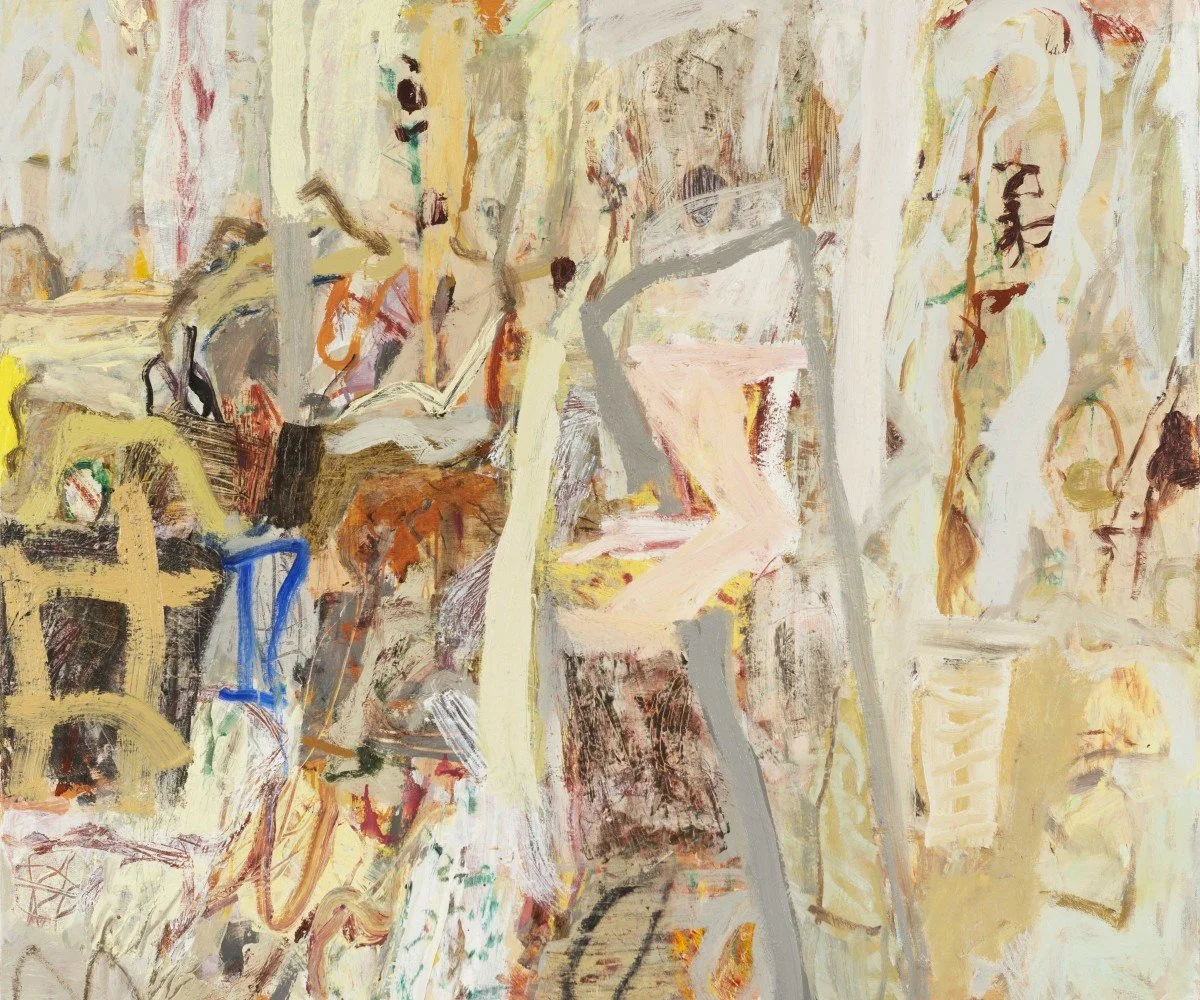
Elisabeth Cummings, “Under the Trees”, oil on canvas, 120×100cm
Image: Michael Bradfield photography, courtesy of King St on William Gallery, Sydney
There is structure, but it is not imposed from above. It emerges from within the painting itself.
That, to me, is the challenge Warren was pointing toward: How to compose a land that does not present itself as composed?.
The Problem of Distance
The Australian landscape extends. It sprawls horizontally. It flattens and then abruptly shifts. The sky dominates. The light is exposing rather than softening. Space is not romantic . It is structural.
In my own practice, I encounter this resistance constantly.
The panoramic format has become a necessary response. The long horizontal plane allows the painting to hold distance without compressing it. It lets the eye travel rather than settle. It mirrors the way the land unfolds, slowly, expansively, sometimes unevenly.

Found, In the Space Between Sprawl and Stillness, Melville oil on canvas 30x120 cm, Found MRAG Exhibition 2025
I paint en plein air in a valley that is changing. Housing developments creep toward paddocks. Roads extend. Fences appear. The land feels both immense and vulnerable. Returning to the same stretch over time allows change to register. The work begins before the canvas in repetition, in standing, in watching.
The landscape is not tidy. It does not resolve into a single moment.
Not Tidy. Not Organised. Not Symmetrical.
Warren’s description — scraggy, bitty, without clear structure — might sound like criticism elsewhere. But in this context, it speaks to integrity.
To paint this land honestly means resisting the urge to refine it into something polite. It means allowing awkward edges. Letting paint thicken and break. Permitting areas of density to sit beside open passages of sky.
Impasto becomes a language of resistance. Thick marks push forward. Thin veils recede. The surface carries both hesitation and assertion. Composition is discovered rather than dictated.
Sky is not background; it is scale.
Space is not emptiness; it is tension.
Distance is not decorative; it is psychological.
Finding Language for What Resists It
One of the quiet difficulties in this work is explaining it.
There is always a temptation to tidy the narrative, to frame the work in clean conceptual terms. But the land I paint does not behave that way. It is expansive, luminous, majestic and also unsettled. Development presses at its edges. Change is constant.
The panoramic format allows the painting to remain open, resisting the urge to make it tidy and resolute. It accommodates interruption. It resists closure.

The Land Remembers, The Soil Keeps Track, oil on canvas, 30x120 cm, MRAG Found Exhibition 2025
Perhaps this is what Warren recognised in Cummings’ work? That painting the Australian landscape is less about imposing order and more about meeting its resistance. About accepting its scraggy edges. About holding light and distance without forcing them into symmetry.
The task is not to correct the land.
It is to stand in it long enough to let it speak which is unevenly, expansively, truthfully.
This is the language of the Australian landscape, and it is the language my work speaks.
Yours in art,
Rebecca
Forthcoming studio release:
‘Hold The Horizon’, June 2026, The Moree Gallery
