
Light & The Landscape
These last two months have seen me return to academic study with a Master of Arts (Fine Arts); it's both challenged and stretched me in many ways that I hadn’t expected; however, I am thoroughly enjoying it. I’m currently studying two courses; one is an extended studio course which looks into contemporary artistic themes including memory, space and light. It is here that I’d like to reflect this month's blog , light and my landscape practice.
Arthur Streeton, artist :
"Yes I sit here in the upper circle surrounded by copper & gold & smile joy under my fly net as all the light, glory & quivering brightness passes slowly & freely before my eyes.”
Barbara Bolt, writer :
“In the glare of the Australian light…..too much light on the matter sheds no light on the matter “
Both Streeton and Bolt recognised an aspect of the Australian landscape which is uniquely ours – the light. The Australian light differs from our European neighbours. European light speaks softly through muted tones and low voices; the Australian light is brash and loud, calling for attention with big skies, high-key tones, and pushy colours.
As a landscape painter, I recognise the beauty and uniqueness of Australian light, and I feel Australian landscape painters respond to it in a particular way. When viewing artwork, one can quickly recognise an Australian landscape before reading the title or artist's name. The palette shifts in tone, the colours are bright and vibrant, and the brushstrokes mimic certain painterly qualities.
At first, I thought my work was (amongst other things) about light in the landscape; however, after much consideration during this recent topic of light, I have come to understand that it is also about the materiality of the materials I use and how light behaves with paint.
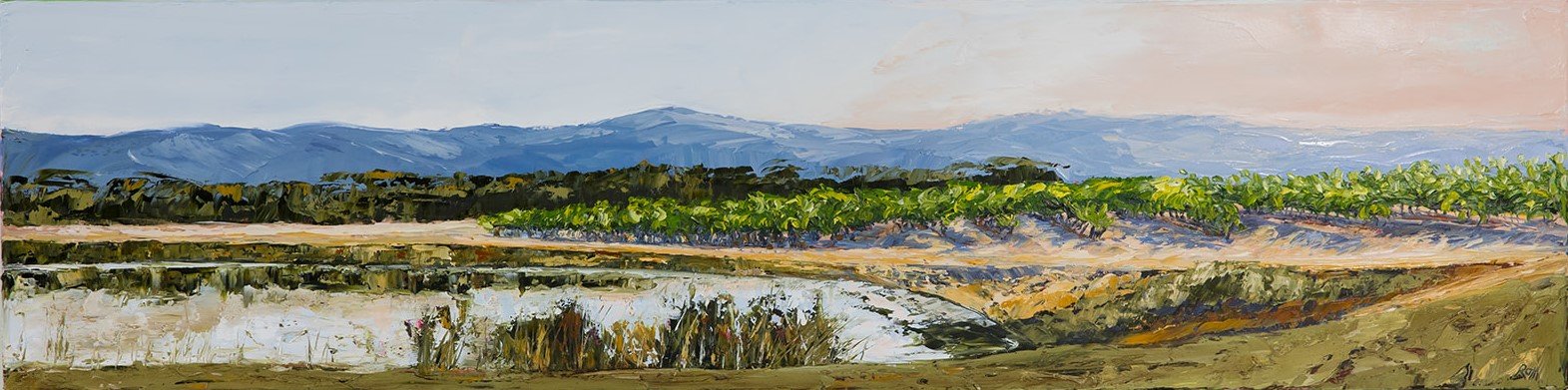
Where the Silence Still Dares to Call, 2025 Vintage Pokolbin, oil on canvas 30x120 cm
I refer to a work I did as part of Found at Maitland Regional Art Gallery, which depicts the dam at my home. The work operates in a twofold capacity; it speaks of the physicality of the light on the water surface, but it is also about how light behaves in paint. Through a glaze process of layering paint, the light plays between the layers of paint to create depth and movement. The magic of oil paint lies in how it interacts with light: through translucent glazes and opaque sections, the paint reveals and then hides; it operates with the light, creating an illusion for the eyes. It's an embodied process, both the act of painting the landscape and viewing the painting each enabled by light.
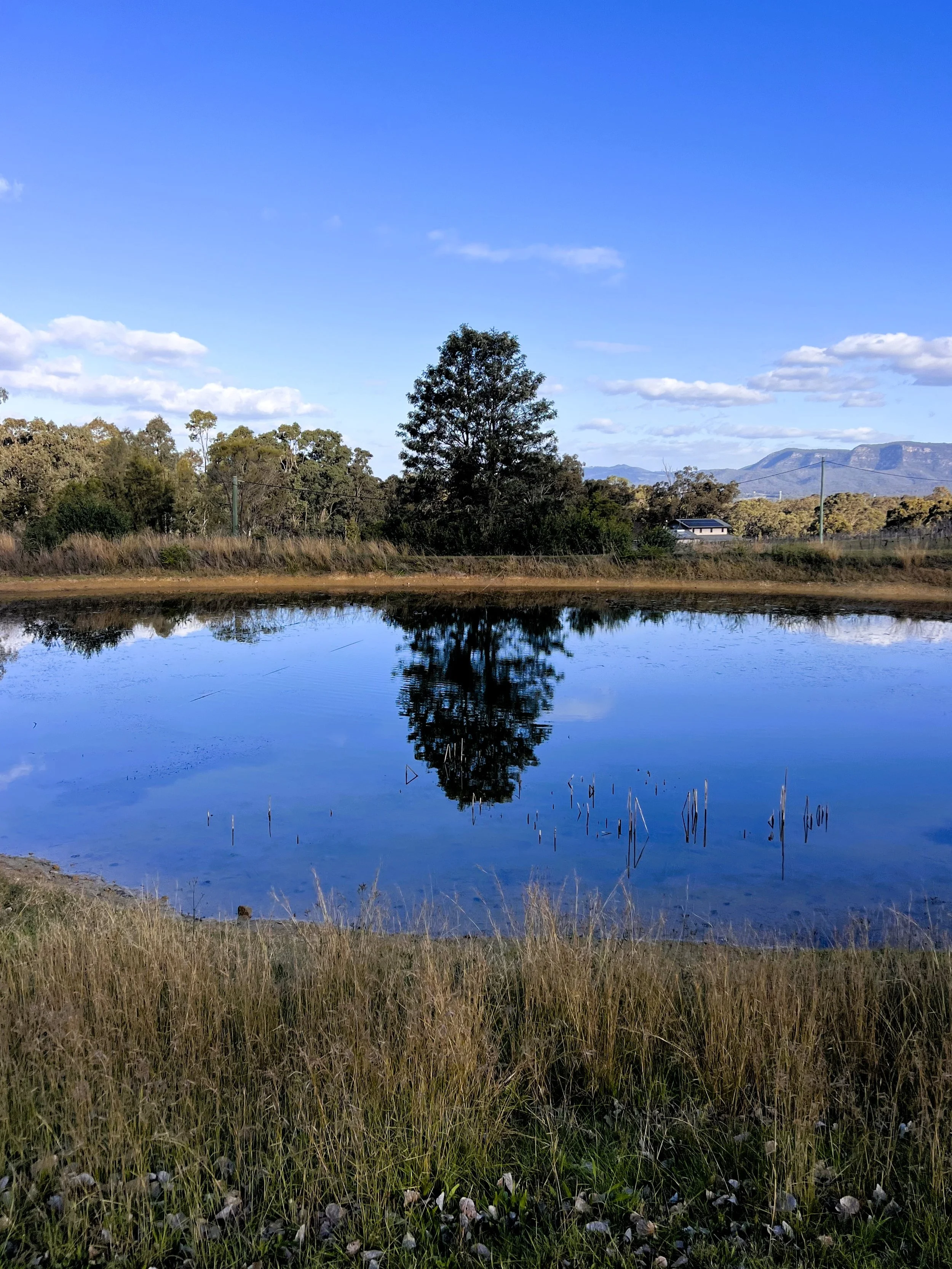
Yesterday the dam reflected the sky so completely that the water seemed to disappear.
The surface became light rather than substance. It reminded me that as painters we rarely paint objects—we paint the light that allows those objects to exist.
Within this subject of light, I’ve reflected on our roles as painters and considered these questions: can light be painted, can light be simply colour, are shadows the absence of light, and why does the Australian light feel so different?
Yesterday I saw only light as something which illuminates objects; today I see it as a lived experience reconstructed through the act of painting. Isn’t it amazing what a day makes?!
Yours in art,
Rebecca
For further reading:
Barbara Bolt, “Shedding Light for the Matter”, In Art Beyond Representation: The Performative Power of the Image. 2004
